While Mobile World Congress tends to focus on telecom networks, Embedded World in Nuremberg is where a lot of the underlying technology behind IoT devices is actually built.
The event took place from 10–12 March 2026, bringing together over 1,200 exhibitors and around 36,000 visitors from across the embedded and IoT industry.
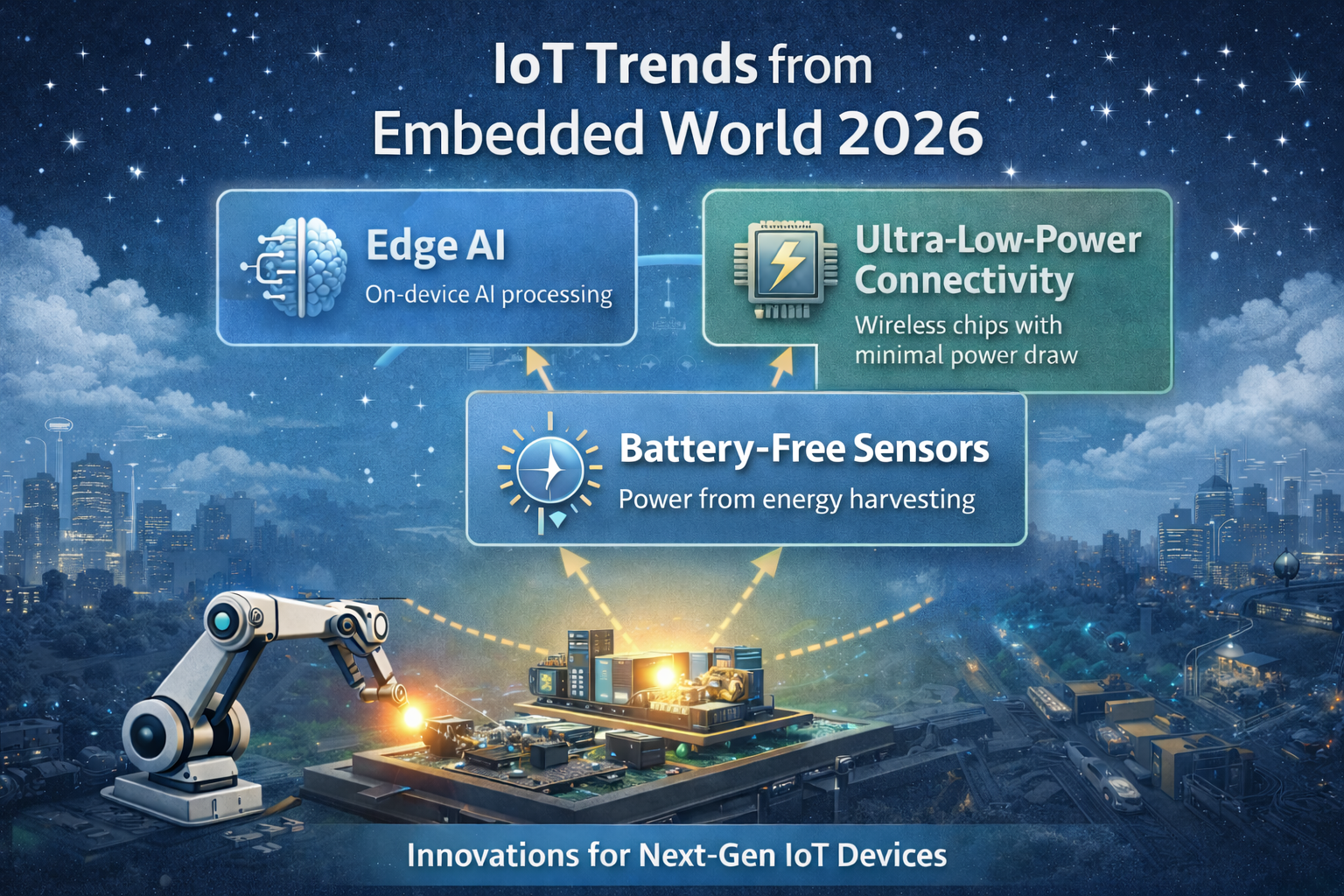
This year’s show highlighted several trends shaping the next generation of connected devices.
Edge AI is becoming standard in IoT devices
One of the biggest themes across the show was AI running directly on IoT devices rather than sending everything to the cloud.
For example, MediaTek introduced a new range of Genio IoT processors designed to support edge AI applications such as robotics, drones, retail automation and smart industrial devices.
These chips allow devices to process sensor data locally, reducing latency and network traffic while enabling real-time decision making.
Ultra-low-power connectivity for IoT sensors
Low power consumption remains a critical requirement for IoT deployments, particularly for devices expected to operate for years on a battery.
At the show, Nordic Semiconductor expanded its ultra-low-power wireless portfolio with new Bluetooth Low Energy SoCs in the nRF54L series, aimed at connected sensors and embedded devices.
Alongside this, the company also demonstrated new battery health monitoring technology designed to help IoT devices run longer and predict when batteries will need replacing.
Battery-free IoT sensors
Energy harvesting and battery-free devices were also a strong theme.
For example, Ligna Energy demonstrated ultra-thin energy storage solutions and indoor sensors designed to operate without traditional batteries, targeting smart building deployments where hundreds or thousands of sensors may need to be installed.
Removing batteries can significantly reduce maintenance costs and improve sustainability for large IoT installations.
The bigger picture
Overall, Embedded World highlighted how IoT technology continues to evolve in three main areas:
- Edge intelligence – AI processing directly on devices
- Ultra-low-power hardware – enabling multi-year battery life
- New connectivity technologies – such as Wi-Fi HaLow and advanced wireless chipsets
Combined, these innovations are helping to enable the next generation of smarter, more autonomous and more scalable IoT deployments.