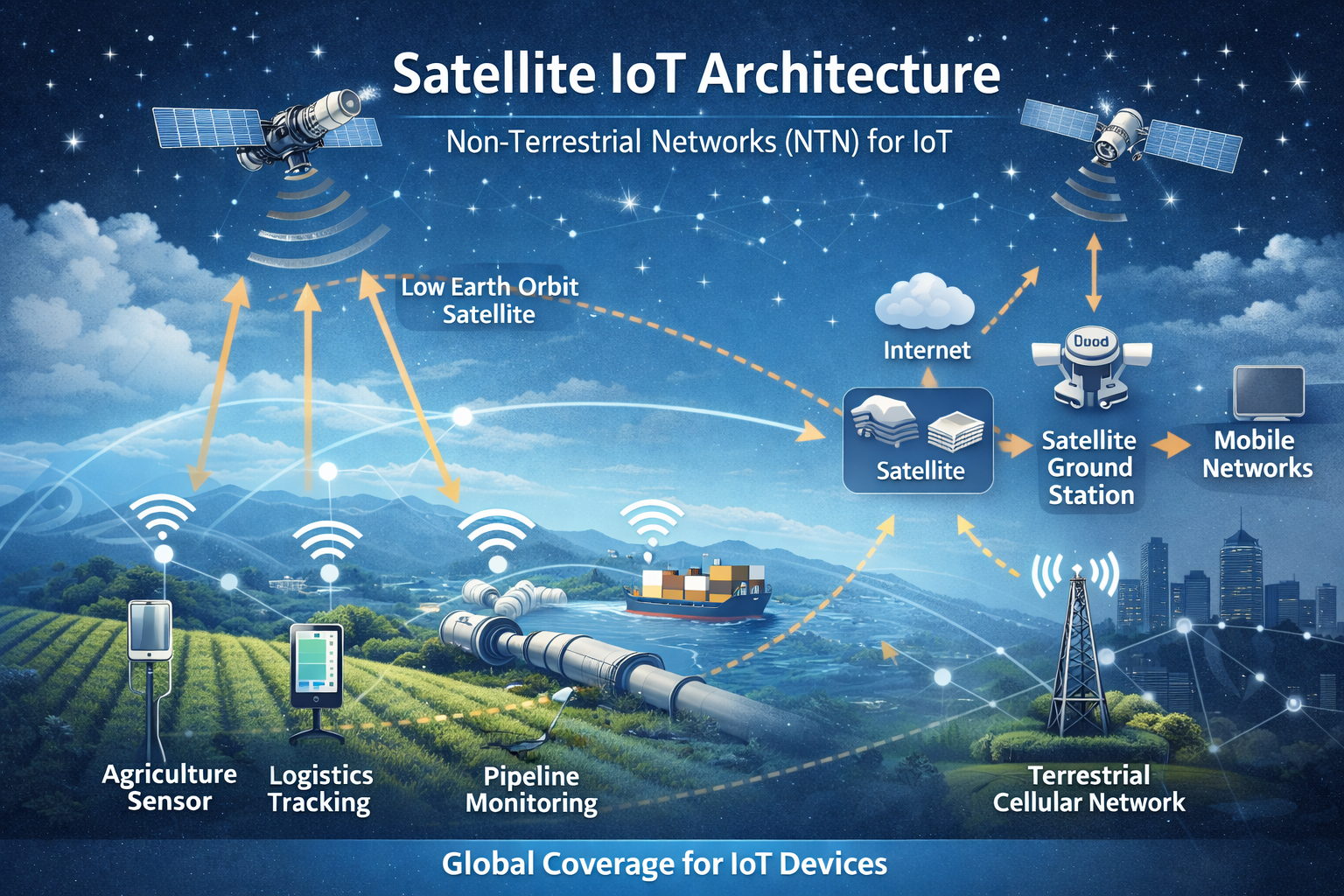
Over the last few years, one of the most interesting developments in connectivity has been the rise of Non-Terrestrial Networks (NTN) for IoT. In simple terms, NTN refers to using satellites to provide connectivity for IoT devices, complementing traditional terrestrial cellular networks.
For many IoT deployments, coverage has always been the biggest challenge. Traditional mobile networks work well in cities and populated areas, but they struggle in remote environments such as offshore locations, agricultural land, deserts, forests or large infrastructure sites. Satellite NTN helps fill those gaps by allowing devices to connect directly to satellites when terrestrial coverage isn’t available.
Why Satellite IoT is Becoming Important
The key advantage of satellite NTN is global coverage. Instead of relying on mobile towers, devices can connect to satellites orbiting the Earth, meaning connectivity becomes available almost anywhere.
This opens up a wide range of use cases, including:
- Asset tracking and logistics across oceans or remote transport routes
- Agriculture monitoring in rural areas with limited network coverage
- Environmental monitoring such as weather stations or flood detection sensors
- Energy and utilities monitoring pipelines, wind farms or remote infrastructure
In many cases, satellite IoT isn’t replacing cellular connectivity it is complementing it, allowing devices to switch between terrestrial networks and satellite networks depending on availability.
The Technology Behind Satellite NTN
Satellite IoT has become more viable recently thanks to developments in both satellite networks and cellular standards.
Several key technologies are enabling this:
1. 3GPP NTN Standards
The mobile industry has standardised satellite connectivity within the 3GPP 5G specifications, allowing existing cellular technologies such as NB-IoT and LTE-M to operate via satellites.
2. Low Earth Orbit (LEO) Satellites
New satellite constellations in Low Earth Orbit reduce latency and improve signal performance compared to traditional geostationary satellites.
3. IoT-Optimised Chipsets
Semiconductor companies are now producing chipsets designed to support both cellular and satellite connectivity while maintaining very low power consumption.
4. eSIM and Remote Provisioning
Modern IoT devices increasingly use eSIM technology, allowing connectivity profiles to be managed remotely and enabling devices to move between different networks.
What This Means for IoT Deployments
Satellite NTN is helping remove one of the biggest barriers to large-scale IoT deployments connectivity in difficult locations.
Rather than designing systems around where coverage exists, organisations can increasingly deploy sensors and devices where they are actually needed.
As satellite networks continue to integrate with mobile infrastructure, we are likely to see a future where IoT devices simply connect automatically to the best available network terrestrial or satellite without the user even needing to think about it.