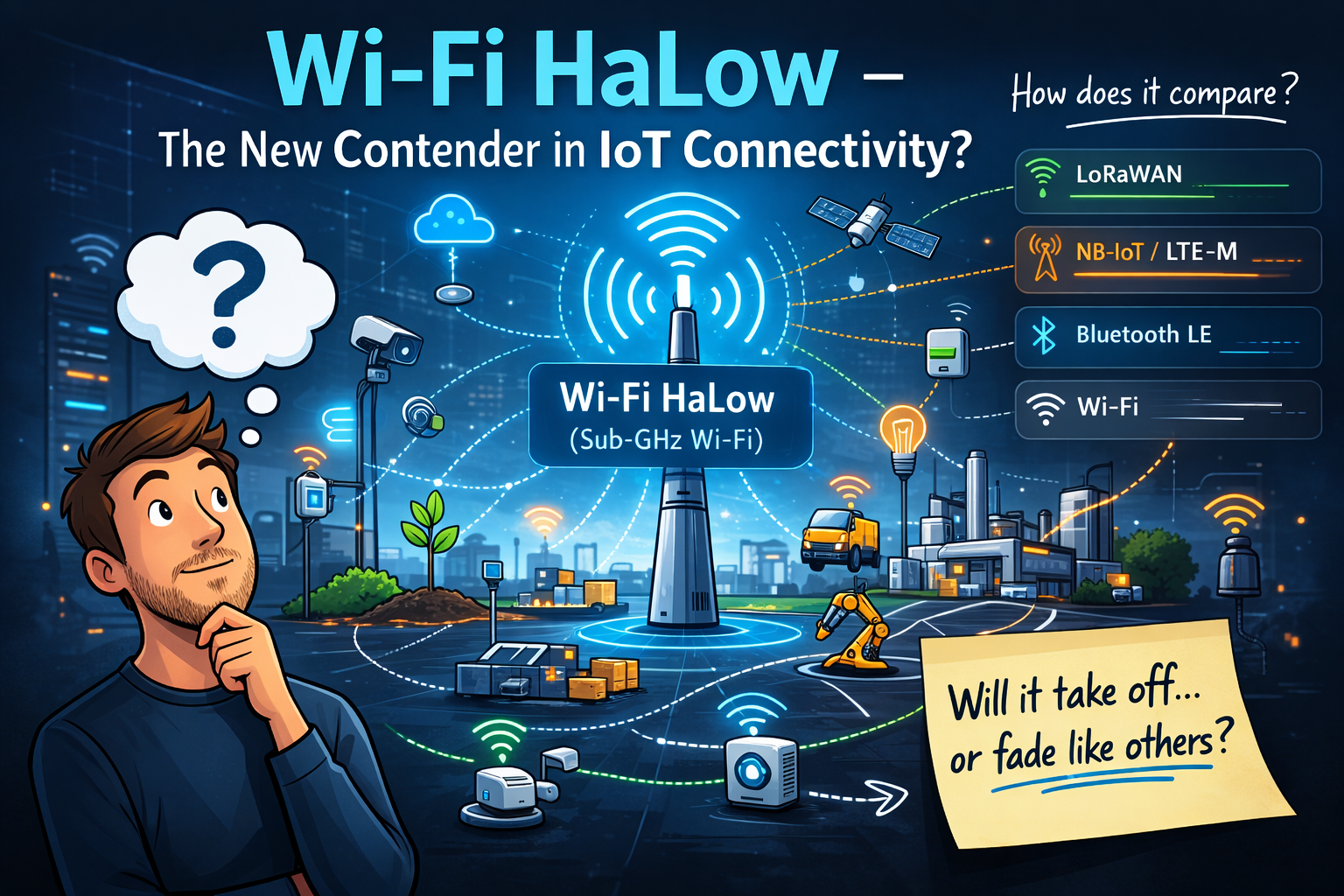
The IoT connectivity landscape never stands still. Over the years we’ve seen a steady stream of new technologies promising to solve the challenge of connecting large numbers of devices efficiently and reliably. One technology that is starting to gain attention is Wi-Fi HaLow. While it isn’t brand new, it’s only recently that hardware, modules and real deployments have begun appearing, which is why it’s starting to show up more frequently at industry events such as Embedded World.
So what exactly is Wi-Fi HaLow, and where might it fit within the growing list of IoT connectivity options?
What is Wi-Fi HaLow?
Wi-Fi HaLow is based on the IEEE 802.11ah standard and is part of the Wi-Fi family, but it operates quite differently from the Wi-Fi we use in homes and offices. Instead of using the traditional 2.4 GHz or 5 GHz bands, Wi-Fi HaLow operates in the sub-GHz spectrum (around 900 MHz). This gives it two key advantages:
- Much longer range than traditional Wi-Fi
- Lower power consumption, making it suitable for battery-powered IoT devices
In some environments, Wi-Fi HaLow networks can reach over 1 km, which makes it attractive for applications such as agriculture, logistics, smart cities and industrial monitoring.
How it compares to other IoT connectivity options
IoT already has a crowded connectivity landscape, with several technologies competing for different use cases.
Some of the most common include:
LoRaWAN - A long-range, low-power technology widely used for smart cities and environmental monitoring.
Cellular IoT (NB-IoT / LTE-M) - Mobile network technologies designed for large scale managed IoT deployments.
Bluetooth Low Energy (BLE) - Typically used for short-range devices such as wearables or consumer sensors.
Wi-Fi HaLow sits somewhere between traditional Wi-Fi and LPWAN technologies, offering:
- longer range than standard Wi-Fi
- higher data rates than some LPWAN solutions
- support for large numbers of connected devices
We’ve seen this before…
The IoT industry has a history of promising new connectivity technologies that aim to become the “standard” some have succeeded, but others have struggled to gain traction. Examples include:
- Sigfox – once widely discussed but ultimately struggled commercially.
- Mioty – an interesting LPWAN technology but still relatively niche.
- Weightless – another technology that failed to reach large-scale adoption.
Because of this, it’s still unclear how widely Wi-Fi HaLow will be adopted.
Will Wi-Fi HaLow take off?
One advantage Wi-Fi HaLow has is the existing Wi-Fi ecosystem. Because it is part of the Wi-Fi family, it may benefit from existing infrastructure, certification programmes and developer familiarity, however, the IoT connectivity space is already crowded, and technologies such as LoRaWAN, NB-IoT and LTE-M are well established. The question now is whether Wi-Fi HaLow can carve out a meaningful niche; it certainly has some interesting technical advantages, but as with many IoT technologies, success will ultimately depend on real deployments rather than technical capability alone.
The real question is, is it one to watch?